Interview with an Author: Kathleen Rooney
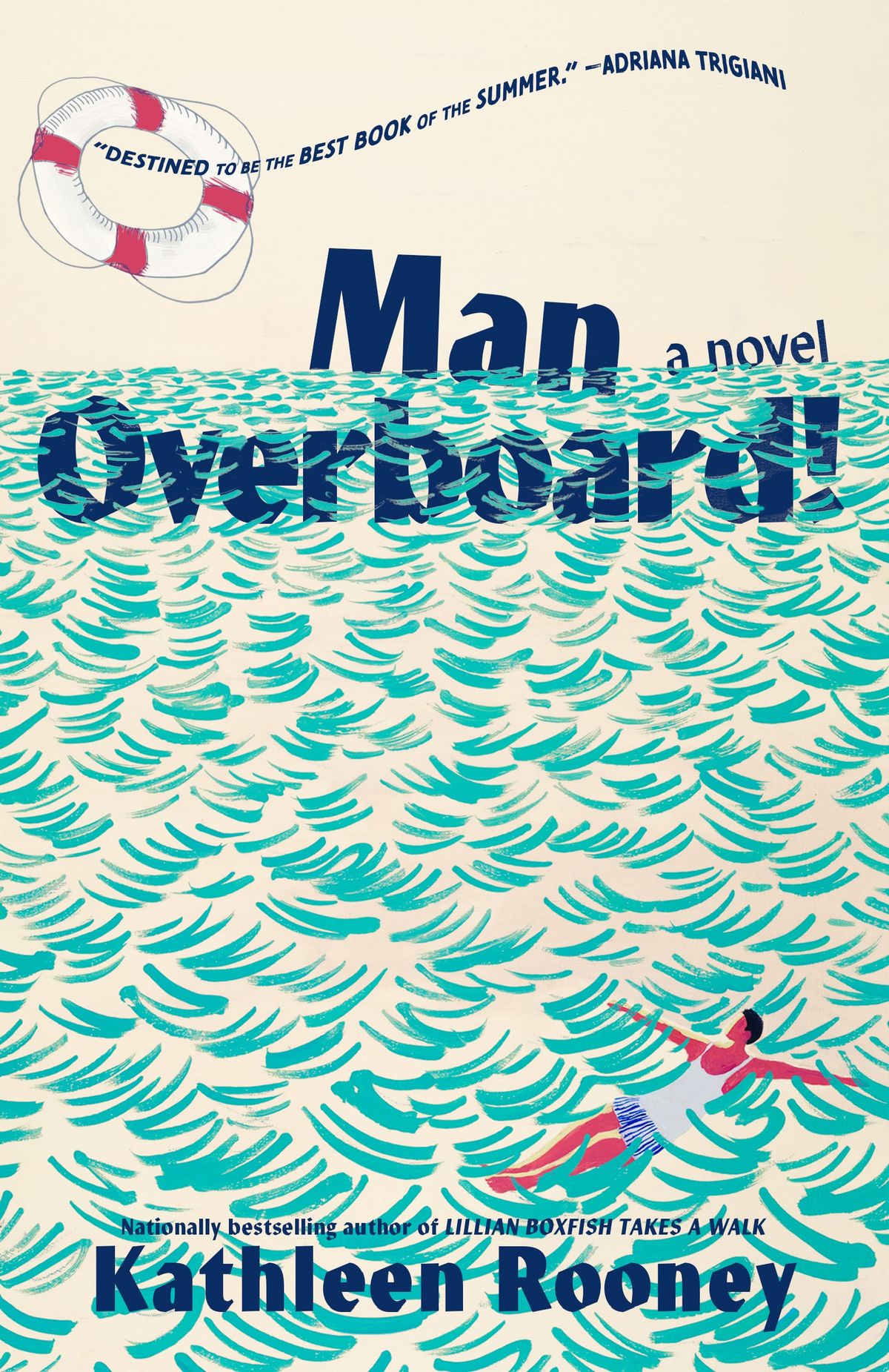
Pre-order your copy of "Man Overboard!" stat

Most people don’t experience life-changing transformation in Muncie, Indiana—but as should be crystal clear to you people by now, I ain’t most people.
Way back in July 2022, I attended the Midwest Writers Workshop, where two incredible things happened: 1) I received affirmation that my outrageous but half-baked novel Leverage was on the right track and 2) I stumbled into the amazing Chicago-based writing duo of Kathleen Rooney and Martin Seay, who are married and were fortuitously teaching craft sessions at the conference.
Fast-forward four years and Leverage is destined to be a cult classic while Kathleen and Martin form the foundation of my literary fam in Chicago. Martin graciously beta-read Leverage and wrote me a pre-publication blurb while Kathleen generously profiled me for Chicago Magazine to support the launch.
Today, on the eve of America’s 250th and final birthday, we’ve come full circle, and I’m absolutely delighted to share the Q&A I conducted with Kathleen to discuss her outstanding new novel Man Overboard!.
Pro Tip: Order your copy by clicking HERE.
I could wax poetic about how funny, charming, wistful, affecting, delightful, insightful, and subversive her latest novel is, and I could rhapsodize at length about Kathleen’s sheer brilliance, but as you’ll see in our wonderful conversation, she can do all that by herself.
So, without further ado, please enjoy my mostly serious, somewhat satirical interview with the novelist, poet, and professor, Kathleen Rooney.
CONTEXT
AG: A quick peek at the list of America’s most popular podcasts makes it clear men are in an ocean of trouble. Why plunge headfirst into the deepest, darkest depths of the so-called masculinity crisis?
KR: I cannonballed into this topic first and foremost because I want us all to swim in a sea of actualization and love, not drown in a whirlpool of resentment and animosity. That kind of harmony can only be achieved if everybody, no matter their gender, does their part. Way back in 2004 in The Will to Change: Men, Masculinity, and Love, bell hooks wrote: “We need to highlight the role women play in perpetuating and sustaining patriarchal culture so that we will recognize patriarchy as a system women and men support equally, even if men receive more rewards from that system. Dismantling and changing patriarchal culture is work that men and women must do together.” Writing a dark comedy about a troubled man for whom I feel immense affection was a super fun way for me to take a whack at the patriarchal piñata.
AG: How did you approach the research process for the novel? What books, movies, newsletters, podcasts, and the like did you consult to determine what’s ailing modern-day men?
KR: Research is my jam. To make sure I could write Man Overboard! convincingly on every level, I created the following categories: the ocean, cruise ships, people who have fallen/jumped/disappeared off cruise ships, famous maritime explorers and survival stories, clowning, swimmers and swimming (amateur and competitive), the Gulf of Mexico and its marine biology/wildlife, the manosphere/masculinity crisis and of course depression and madness, plus suicide. As I looked into these last few, it became clear that most of what the manosphere espouses leads to depression, madness, and suicide, if not of a literal variety, then the killing off of the most noble parts of oneself in order to win at being a real man.
The sources and figures that illustrated that suicidality most strongly include but are not limited to: The Joe Rogan Experience, Fresh and Fit, The Art of Manliness, Andrew Tate, Tucker Carlson, Jordan Peterson (especially 12 Rules for Life), The 48 Laws of Power by Robert Greene, and many more. I was actually nervous, going into my research, that I might get red-pilled, to use the term of art. I was leery that somehow this ideology might be so persuasive that I couldn’t help myself and would—like the thousands if not millions of men who buy into this sad and self-destructive view of the world—somehow join their ranks. But I—like Kick, my protagonist—found this ideology sorely lacking. These content creators rely on flimsy, cherry-picked examples from evolutionary biology (about which none of them are experts) and apocryphal history (none of them are historians either) and an almost comically shallow interpretive take on philosophy and mythology. The end products of these approaches strike both Kick and me as silly and unconvincing.
The subtitle of Peterson’s book is “An Antidote to Chaos” and to be sure, we could all use one in these chaotic times, but finding that antidote among these sources is like drinking poison and telling yourself it’s medicine. It makes you worse.

I also looked into sources that offer real and actionable ways for men to do better, which to me involves focusing on development instead of competition and grievance. Significantly, most of these are older and literary, not contemporary and self-help adjacent. Iron John: A Book About Men by the poet Robert Bly would help many a man. As would anything by the aforementioned bell hooks.
AG: What did you learn that surprised you or changed your perspective? Conversely, did any findings harden or reinforce your callously feminist worldview?
KR: First, I suppose I have to articulate my worldview which is that love is the answer to everything. But we live in a culture that trains boys from babyhood to narrow their register of acceptable emotions to anger only, and anger expands like a hot nasty gas to fill all available space, crowding out all other emotions, including love. In the novel, you see this phenomenon best in Kick’s father, who is a severely emotionally constipated individual. He suffers and thus inflicts suffering on others, including Kick’s mom, his son and—though he would never admit it—himself.
I guess maybe boys are also allowed to have irony and silence, if those can be considered emotions? As a consequence, we have half the population coming of age in a severely emotionally stunted state. Love requires mutual vulnerability—we have to be able to look at the other person or group of people and see that they have needs and weaknesses just as we ourselves do.
Love requires mutual vulnerability.
Writing this book confirmed for me my intuitive sense that when many men look inside at their feelings, it’s like they see a blasted wasteland full of piles of rubble they can’t even identify. That’s bad. It’s bad for men and it’s really bad for the women and children and every other being who has to deal with them because not being able to understand and regulate one’s inner state leads to a lot of misdirected lashing out, driven by insecurity and fear.
Kick as a character is really afraid. He’s been walking around for the majority of his life stuffing down and hiding his true desires and legitimate emotions out of fear of losing face or not being “respected” or just being “weird” and ultimately that repression winds him up fighting for his life in the middle of the sea.
AG: Last year internet talking head Scott Galloway published a memoir called Notes on Being a Man. I have not read this book, but I thoroughly enjoyed The New Yorker’s vicious review, which argued all the problems plaguing men could be better described as problems plaguing people. In your assessment, how much of the plight of men—economic insecurity, educational inequity, mental health woes—is legit gender-specific, and how much is, to use the parlance of our times, men being pussies?
KR: I haven’t read that book either, though it certainly does seem a worthy target of The New Yorker’s skewering. And I absolutely think that breaking those problems down along gender lines divides and conquers us. Capitalism as a system and the people and structures—corporations, broligarchs, governments that have been captured by elites of all stripes—that support and benefit the most from it have a massive stake in trying to keep us fighting each other. They profit from keeping us thinking things like “My profession has become feminized” or “College is for girls” or “An immigrant took ‘my’ job” or “A Black person got ‘my’ spot” and so forth. But it will take real solidarity to achieve the better world that is possible for us all, a world where everyone has access to clean water, food, income, healthcare, meaningful work, and a chance to cultivate that which is best in them and thrive spiritually as well as economically.
The people united will never be defeated! is one of my favorite slogans to chant at a demonstration because it’s so true—we have to unify. It’s not man versus woman or any other category versus any other category; it’s humanity against the anti-humanist forces that would exploit and vampirize us all and leave us for dead, no matter what boxes we check on bureaucratic forms asking for our race and gender.
CRAFT
AG: The structure of your novel is simple yet profound: A man falls off a cruise ship and has to tread water as long as possible in the hopes somebody—anybody!—will come and rescue him. The first-person narration largely relies on memories and flashbacks as a result, which embeds the reader deep in the mind of the character. How did you cook up this idea?
KR: At DePaul, where I teach, I do a Craft of Poetry class whose title is Obstructionism and whose organizing principle is finding freedom within constraint. Over the course of ten weeks, we write eight original poems to a set of diabolically specific prompts, which pushes everyone to move beyond just self-expression and into the realm of forms and structures. I never make my students do anything I wouldn’t do, and I love writing work with a strict overarching structure. So I wanted to see: Could I wrote a short, compact, first-person, present tense novel that takes place in less than a single day—in this case Thanksgiving—where each chapter chronicles one hour in the water.
Also, I am terrified of the ocean. I love it so much but I fear and respect it and really liked the idea of making myself go very deep (pun intended) into my own phobia. Survival stories are elemental and I wanted to try my hand at writing one.
AG: Your messy but plucky protagonist, Patrick “Kick” Kilpatrick, is an aimless fitness instructor and depressed former jock with a potty mouth and a penchant for casual sex. As a classy White lady and sophisticated college professor, how did you get into the right state of mind to write about a character like him?
KR: What can I say? Fiction is magic. I like it when a fiction writer can compellingly write a character who is extremely different than themselves. Probably the biggest example of my doing this so far is with Cher Ami and Major Whittlesey, a World War I novel in which I wrote in the alternating first-person perspectives of a dead messenger pigeon and a gay soldier; I am neither a pigeon nor a soldier. But with research and imagination and empathy there is nothing we are not capable of. I think that’s true in art and in life. I don’t buy it when people say things like, “But do we ever truly know another person?” Like, duh, yes, of course we do! Understanding and sympathy are possible. Fiction is an art form that—at its best—illustrates this.
Fiction is magic.
Also, per the above answer about solidarity and humanity and anti-capitalism, the things that unite us are more important than the things that divide us. We are all the same; we are all enmeshed; the fate of one of us cannot be separated from the fate of us all. There are no others. Like Walt Whitman said: “Every atom belonging to me as good belongs to you.”
AG: When Kick first finds himself in “the fucking sea,” he’s hella drunk, and neither he nor the reader are quite sure if his nosedive was accidental or intentional. From there, Kick’s internal monologue examines his one-sided battle with depression and the possibility he has made a suicide attempt. Can you tell us about how you tackled this sensitive yet salient topic—particularly with such care, compassion, humor, and wit?
KR: My sister in Philadelphia recently pointed out, on the occasion of this book’s publication, that I’ve written about suicide a lot, and I have. She was checking if I was okay. I am! I keep coming back to this topic because capitalism is a death cult. It puts us in these intolerable positions of hurting each other, the planet, and ultimately ourselves; it’s a self-harm machine as well as a machine that harms others, all in the name of profit. As a system, it’s naturalized; we are told this is the way things are, that there is no alternative. The impoverished existence it insists we all willingly accept is enough to drive one crazy, to drive one to throw oneself into the sea.
Capitalism is a death cult.
I’ve done a lot of reading on the topic of the relationship between mental health and one’s material conditions, but my favorite thinker on this topic is Mark Fisher, who took his own life in 2017. In his book Capitalist Realism: Is There No Alternative? he writes:
“The current ruling ontology denies any possibility of a social causation of mental illness. The chemico-biologization of mental illness is of course strictly commensurate with its depoliticization. Considering mental illness an individual chemico-biological problem has enormous benefits for capitalism. First, it reinforces Capital’s drive towards atomistic individualization (you are sick because of your brain chemistry). Second, it provides an enormously lucrative market in which multinational pharmaceutical companies can peddle their pharmaceuticals (we can cure you with our SSRIs). It goes without saying that all mental illnesses are neurologically instantiated, but this says nothing about their causation. If it is true, for instance, that depression is constituted by low serotonin levels, what still needs to be explained is why particular individuals have low levels of serotonin. This requires a social and political explanation; and the task of repoliticizing mental illness is an urgent one if the left wants to challenge capitalist realism.”
AG: In what first appears as a random aside, Kick has a clandestine desire to perform as a clown, and the novel explores the history of clowning while providing several fascinating factoids. What got you interested in clowns and why are they important to Kick’s characterization?
KR: Though it goes against popular opinion, I’m fascinated by clowns! Always have been, ever since I went to my first circus. I, like Kick, was an inveterate watcher of The Bozo Show. Clowns are unkillable! They get brutally hurt but emerge unscathed and take incredible risks but never die. Clowns are showmen, who derive from shamans—figures who have descended into the underworld, endured, and come back to tell the rest of us what they have learned. I like this idea of clowns as sort of holy fools, figures who seem maybe silly or fun (or admittedly annoying) on the surface but reveal deep metaphysical truths. Kick is not so heady about it, but he intuitively senses that if he studies clowning, he will find the spiritual sustenance he’s sorely lacking in his regular life.
AG: There’s a clear and rightful call for environmental protection and preservation throughout the narrative, and Kick encounters several amazing sea creatures during his ordeal. Can you talk about why you felt it was important to include this element in the book?
KR: First, I love our miraculous planet Earth and I grieve every day over the violence that humans as a species are perpetrating against it. Our Earth is an environment uniquely suited for life, a place full of so many awe-inducing creatures and ecosystems that even the most capacious brains can’t fully comprehend it. The sea beasts and their wisdom are a way to celebrate and mourn our home.
Additionally, part of how men or anybody else can “fix themselves” is to start by getting over themselves. Kick needs to look beyond the confines of his own pain to see how it connects to everybody else’s. As the dolphin with the unpronounceable name tells Kick: “Everybody out here is going through something.”

CONCLUSIONS
AG: In subtle ways, your novel is a proclamation of the power of literature, and Kick, while flawed, has avoided a full-blown descent into manosphere madness because he’s been an avid reader his entire life. Of course you, a fancy feminine literary type, would believe such flimsy flimflam. So, can you explain to men why reading fiction is so uniquely nourishing for the soul?
KR: As Pringles the seahorse says: “It’s hard to hate anyone once you’ve heard their whole story.” Fiction is a uniquely portable piece of human consciousness. Nonfiction is great, too, and so is poetry, but fiction—at least when it’s character-driven and focused on a dynamic protagonist capable of internal and external change—lets us see inside another person’s heart and mind in a 100% fully-realized, 360-degree view sort of way that is rare in real life. We get to understand everything they do, maybe better than they understand it themselves, the good and the bad and the in-between. I’m nosy as hell and I adore the way fiction lets me satisfy my curiosity about other people so completely—in fiction, nothing is too invasive, you can see it all. It’s magic. I pity the fools who don’t read fiction.
I pity the fools who don’t read fiction.
AG: If men were to read your book, what would you hope they’d take away from the experience?
KR: I hope they laugh out loud at my many excellent jokes; women still suffer from a stereotype that they are not as funny as men and that’s just not true. Beyond that, I hope they are entertained and get really invested in whether Kick lives or dies, and from there, that they think about the lives they are living and if there are aspects they want to change before it’s too late.
AG: Can men still be fixed?
KR: Every single minute we are alive is a chance to change. It’s never too late. A better world is possible. Yes!